

Brisa Laman Kitchen Safety Onboarding Training — Linear Edition
2.1 Receiving Deliveries and Safe Storage
Receiving is a checkpoint, not a handover
Deliveries arrive at the staff entrance, the same door with the handwashing sink and the two extinguishers. Do not accept a delivery while you are in the middle of another task, and never sign for goods you have not inspected. Once you sign, the product is Brisa Laman's responsibility and the driver is gone.
Before anything comes off the vehicle, check that the truck is clean, that chilled and frozen goods are separated from dry goods, and that raw proteins are not stacked above ready-to-eat products.
What you check, in order
Temperature first, because it degrades fastest. Take the temperature of chilled deliveries with a clean, sanitized probe between two packages, or use an infrared thermometer on the surface. Chilled products should arrive at 5 °C (41 °F) or below. Frozen products should arrive at or below −18 °C (0 °F) and be solidly frozen. Live shellfish and fresh fish should arrive on ice, with fish firm, bright-eyed, and smelling of clean seawater, never of ammonia.
Packaging next. Reject torn, crushed, water-stained, or leaking cartons. Reject dented, bulging, rusted, or unlabelled cans. Reject vacuum packs that have lost their seal, and frozen goods showing large ice crystals, frozen liquid at the base of the box, or soft edges. These are signs the product thawed and was refrozen.
Then dates and labels. Confirm use-by and best-before dates leave enough working life, that the product matches the invoice, and that allergen information is legible.
Finally, look for pests: droppings, gnaw marks, or insects in the packaging.
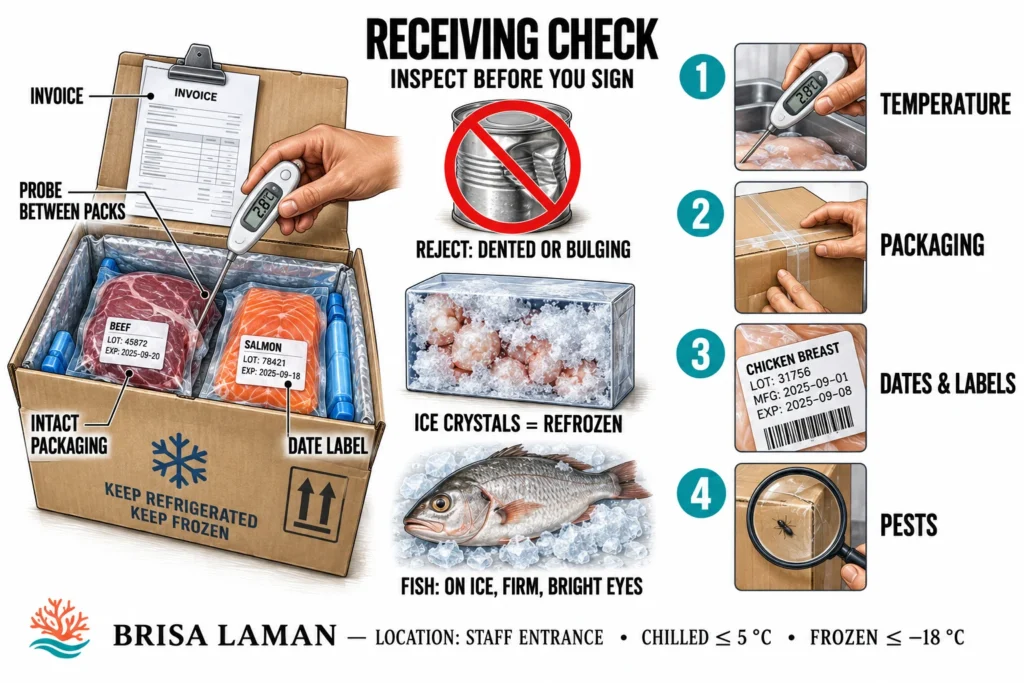
Temperature
Probe chilled and frozen food before you sign: chilled 5 °C or below, frozen −18 °C or below.
Packaging
Check boxes and wrapping are sealed and undamaged; reject torn, leaking, dented, or bulging packs.
Dates and labels
Check every item has a clear label, lot number, and a use-by date that has not passed.
Pests
Look for insects, droppings, or gnaw marks; reject any delivery with signs of pests.
Rejecting safely
You are authorised to reject. Set the item aside, mark it clearly, note the reason on the delivery document, and tell Chef Dominic or Marisol immediately. Do not put a rejected item into storage "until someone decides." It will be used.
Storing it correctly
Chilled and frozen goods go away first, within fifteen minutes. Dry goods can wait; a defrosting box of snapper cannot.
Label everything that leaves its original packaging: product name, the date it was opened or prepared, and the discard date. Practise FIFO, first in, first out. New stock goes behind or below existing stock so the oldest is always reached first.
Inside the walk-in, storage order protects you. Ready-to-eat foods, cooked items, and desserts go on the top shelves. Below them, raw fish. Below that, whole cuts of raw meat. On the bottom shelf, raw poultry. Nothing raw ever sits above anything ready to eat, because drips travel downward. This is the walk-in version of the wall rack: red for raw meat, yellow for raw poultry, green for fruits and vegetables, white for dairy and bread. One board, one food family; one shelf, one risk level.
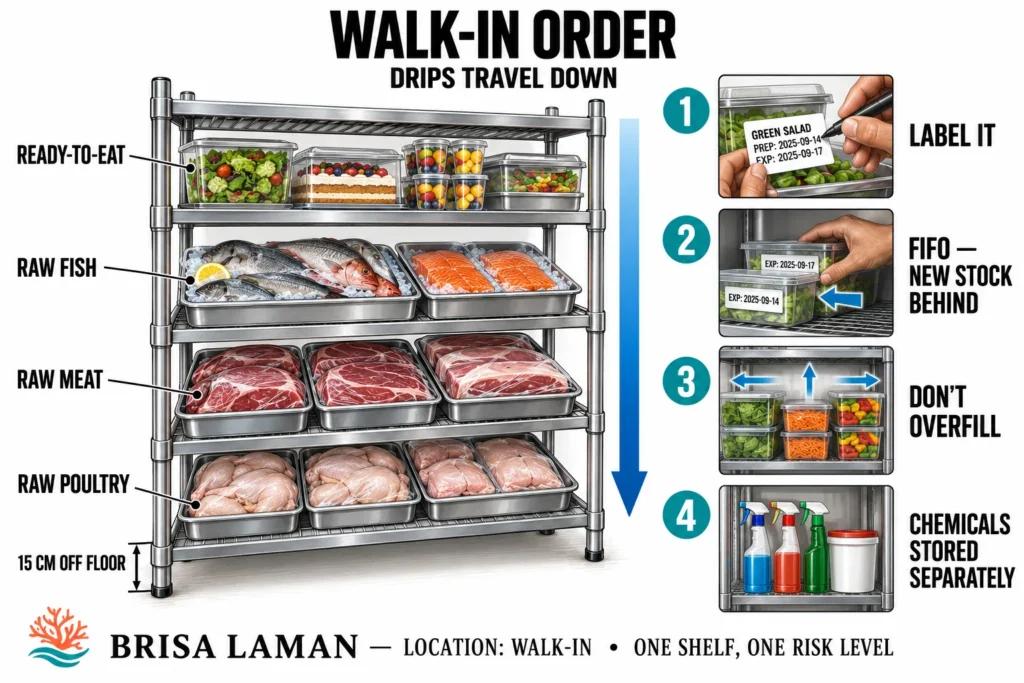
Label it
Label every container with the item name, prep date, and use-by date.
FIFO: new stock behind
First in, first out: put new stock behind older stock so the oldest is used first.
Do not overfill
Leave space between containers so cold air can circulate freely.
Chemicals stored separately
Never keep cleaning chemicals in the walk-in; store them in their own labelled area.
Keep everything at least 15 cm off the floor, away from walls, and out of direct airflow from the fan. Do not overfill shelves, because cold air needs to circulate. Never use the walk-in to cool hot food in sealed containers.
In dry storage, the orientation rule stands: keep boxes, oils, and linens away from heat sources, and never stack anything near the cook line or equipment vents. Keep chemicals in their own area, never above or beside food.
Finish Course Early?
You have not completed all required lessons and assessments.